Legal Cheating in IHSA Sports is Ruining “The Experience”
Make it stand out
Whatever it is, the way you tell your story online can make all the difference.
I was driving through south suburban Calumet City last week when I noticed a woman placing a sign on her front lawn. It read: “Home of a Mt. Carmel Football Player Go Caravan!” The team was preparing for its state championship game against Oswego, which was delayed four days due to weather. The Caravan would indeed go on and win its historic 17th state football title, defeating Oswego 20-3. Of the 49 years the state finals have been held, the Caravan has won 34 percent of the titles and finished in second place five additional times. Impressive? Yes. However, a closer examination reveals that the IHSA rules permit non-boundary schools such as Mt. Carmel, Brother Rice, Fenwick, Montini, and St. Francis, who all emerged as state champions this season, to select the best athletes in a specific sport with little recourse, highlighting the need for a change in this system of crowning champions in IHSA sports.
In an apple pie baking competition, you are given the opportunity to select four apples from a barrel as ingredients. Your barrel contains eight apples, all picked from the same local farm. Your opponent’s barrel has 200 apples, picked from 20 farms throughout the region, and you both have four hours to select the best four apple ingredients for your pie. I don’t care how long you stare and examine those eight apples to pick the best four; you are going to lose. It won’t matter if you are Chef Gordon Ramsay; your competition has a clear advantage in terms of ingredients to choose from. This is how the IHSA system is set up for all state playoff series sports, not just football.

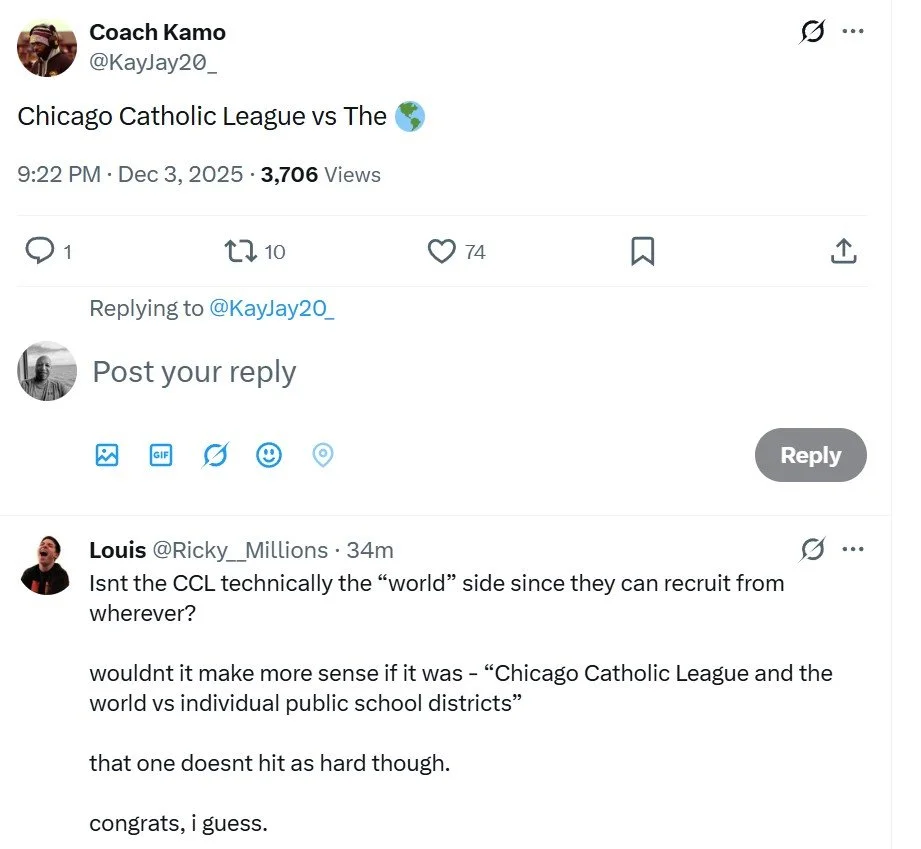
The Chicago Catholic League's strong performance this year in football was center stage. Of the eight classes in football that offered a state championship, CCL teams won five of them. While supporters of CCL schools boasted about their achievements online, supporters of other schools in the state criticized them for their unfair advantage. The social media criticism was at times vicious and funny but always on point.
“When you can poach the best athletes from surrounding communities, this is the logical outcome,” replied @Fletcher90210 on X to a user that was bragging about how CCL teams not only won the state championships but also the Prep Bowl, which puts a Chicago Public League school against a Chicago Catholic League school.
“Club team. Huge advantage over public teams,” responded @FIHSA1989, which is a parody account of the IHSA.
However, perhaps the best post on the subject also came from the @FIHSA1989 account. The facts in the post were independently verified by Jcoydenreports. It gave a breakdown of the state football playoffs the last 25 years.
“Here's your annual inequity data on IHSA postseason football: Private schools won 82% of its games vs. Public. Private made up 9% of playoff field, won 5 out of 8 Championships *Since 2001 Private made up about 9% of playoff field but have won 40% of the championships.”
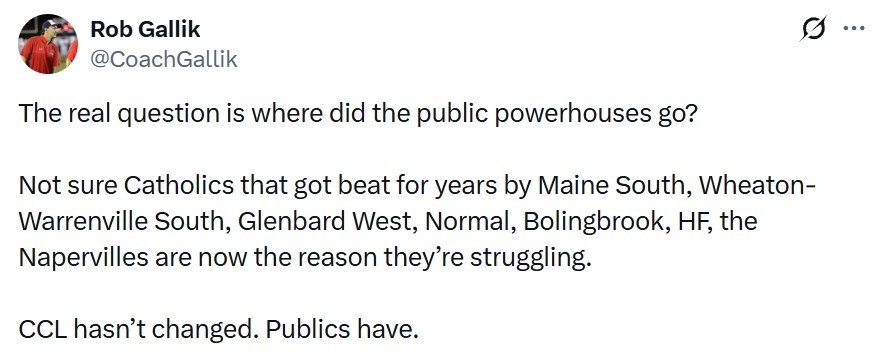
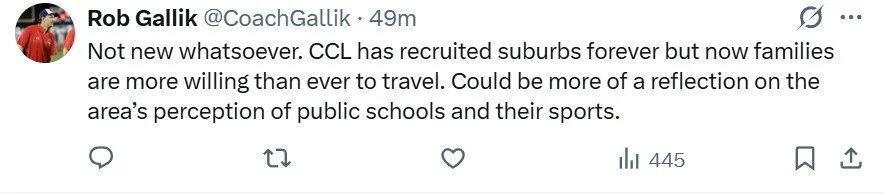
Local coach Rob Gallik (@CoachGallik), a St. Rita graduate, was particularly bold and outspoken on X about CCL’s historical recruiting efforts. He proudly stated how St. Rita and other CCL teams recruit throughout metro Chicago, not just in the city where St. Rita is located.
“Not new whatsoever (recruiting). CCL has recruited suburbs forever…” is how he began one tweet. ”
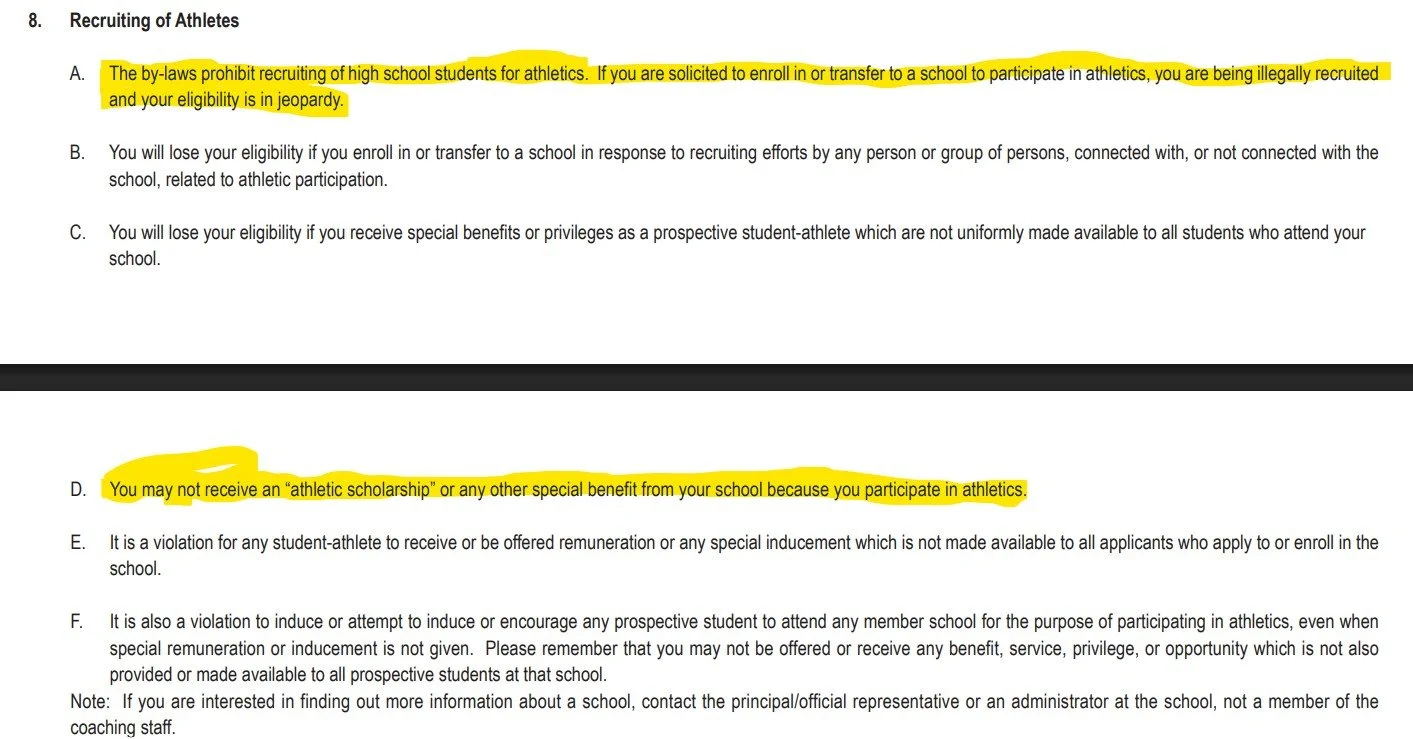
According to IHSA bylaws, which are published on the IHSA website, what CCL schools are doing is prohibited, and the schools should face penalties. In addition, the players who were recruited themselves should be ruled ineligible. The fact that it never happens is what is drawing the ire of the public.
Defenders of CCL schools openly admit that while they may recruit or offer “athletic scholarships,” which is technically a violation of IHSA bylaws, there are several suburban Chicago schools that also recruit athletes to their schools. Everyone agrees on this point, but there is one vast difference: parents who illegally enroll their children in a public school district that is outside of their residency boundary can be arrested and sent to prison. No such law is on the books for non-boundary private schools.
“Enrolling a child illegally in a public school in Illinois is a Class C misdemeanor, punishable by up to 30 days in jail, a fine of up to $1,500, or both. The penalty applies to anyone who knowingly enrolls a nonresident child in a tuition-free school or knowingly provides false information about a child's residency to avoid paying nonresident tuition,” according to Indian Prairie School District #204, which is based out of Aurora, Illinois.
Perhaps enforcing this law, would drastically reduce the number of illegal transfers and recruiting to suburban public schools. However, I could not find a recent case where an adult was prosecuted for committing this crime in Illinois. Could you imagine a press conference with Illinois Attorney General Kwame Raoul announcing the arrest and prosecution of 12 head coaches and principals at suburban schools for illegally registering students? Additionally, there would be dozens of parents' mugshots featured on your local news after they were charged with providing fake addresses and utility bills to enroll their children in a school solely to allow them to play on a team. The message would be clear and unambiguous but not likely to happen.
Law enforcement, though, doesn’t solve the problem with what to do with the non-boundary schools. That is something the IHSA itself must address. The IHSA has a shady history of when and who it enforces punishment against. If it is a Chicago Public School, they seem to have no problem with doing investigations and finding fault. Just this week the basketball coach at Kenwood was suspended four games because his team participated in an illegal scrimmage against Leo, one day before the season technically started. The Leo coach got the same punishment, but four games for an illegal scrimmage? And how exactly did they get this information that there was an illegal scrimmage taking place?
The IHSA has consistently demonstrated a lack of clarity and predictability regarding the enforcement of their own bylaws. The IHSA could probably be forced to look at their non-boundary rules if pressure was applied by someone like, say, Gov. J.B. Pritzker, who is also likely to run for president in 2028. While the IHSA is a private entity, Illinois legislators do have some recourse here. A few years ago, they passed a state law making it mandatory for IHSA coaches and sports officials to pass a Concussion Management Program every two years. Every two years, a mandatory Hate Speech and Harassment video is also required. Some state legislator looking to run for higher office could easily put forth a bill requiring the IHSA to make some changes. Call it the “Fair Competition Act.” I think state Senator Napoleon Harris would be a great sponsor of such a bill as he is a former professional athlete, was an all-state football player and a member of Thornton’s state runner-up basketball team in 1995.
What about other schools throughout the state that don’t have nearly the population centers that the Chicago metro area has. What are the chances of the 3A and 4A schools in those areas to competing for state titles? East St. Louis has been impressive the last few years in football and has a storied tradtion of teams and athletes going back to LaPhonso Ellis in basketball and Olympic champions Jackie Joyner-Kersey and Dawn Harper-Nelson in track & field. They are the closest thing to a powerhouse in other parts of the state.
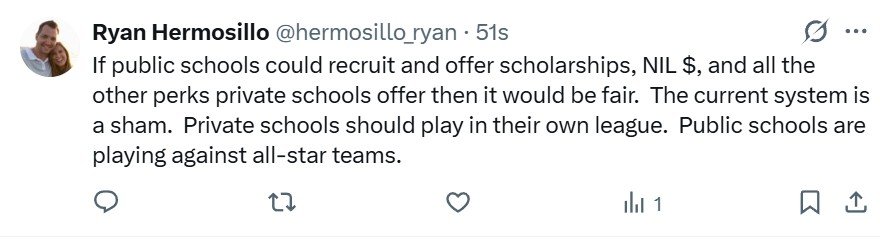
However, it appears that the best ideas for addressing this glaring problem of the advantage non-boundary schools have over everyone else seem to come from the public itself. Hundreds of high school sports fans and just people in general who look at the system say there needs to be a separate class created for non-boundary schools. Since they are already allowed to “legally cheat,” why not let them only play against others who do the same when it comes to the state playoffs? Create a new class where recruiting is legal and athletic scholarships, NIL deals, and anything else you can think of are allowed, and let them have at it. Keep everyone else in the current system and strictly enforce the current bylaws or update them as needed.
I remember covering the news about 20 years ago when the IHSA added two additional classes to basketball, baseball, volleyball, and softball, moving it from two classes to four. The logic was to give smaller, mostly rural schools a chance to compete for a state championship. It was a wonderful decision. Why then would it be so difficult to create another class for non-boundary schools in these very same sports?
I would take that even further. This is due to the presence of select-enrollment high schools in Chicago, which consistently excel in sports and win numerous city championships. Lane Tech, which has the second-largest student enrollment in the state (4,512), is competitive in every sport. Whitney Young also has had over a decade of dominance in city titles across multiple sports. These schools can sometimes compete with non-boundary private schools on the state level, but they have a clear advantage over neighborhood high schools like Kennedy, Corliss, Fenger, Manley, and Amundsen for local championships. You can include Lane, Young, Payton, Jones, Lindblom, Westinghouse, and the five other select enrollment schools in Chicago in the non-boundary school division if you'd like to, but they would still be at a slight disadvantage because they wouldn’t be able to enroll students from the suburbs like CCL teams can.
Both Fenwick and DePaul College Prep announced earlier this month that they will be starting major infrastructure upgrades to their campuses that will include new athletic facilities. No doubt some of that funding has come from athletic boosters, excited by the schools’ success on the athletic field in money-generating sports like football and boys’ basketball. Speaking of basketball, last year no Chicago Public League boys’ basketball team made it to the state semifinals in Class 3A or 4A for the first time in two decades. You know who did make it? Three Catholic schools, all from the CCL. DePaul defeated Mt. Carmel to win the 3A title, while Benet beat Warren to win the 4A title.
Three of the top five teams in the Chicago Sun-Times preseason basketball rankings were Catholic schools. Simeon and Curie rounded out the Top 10. With the merging of the of the former Eastern Suburban Catholic Conference into the CCL, the Catholic schools are consolidating power. If you think the CCL is going to stop purging athletes with just football, you also must believe that winter is over in Chicago.